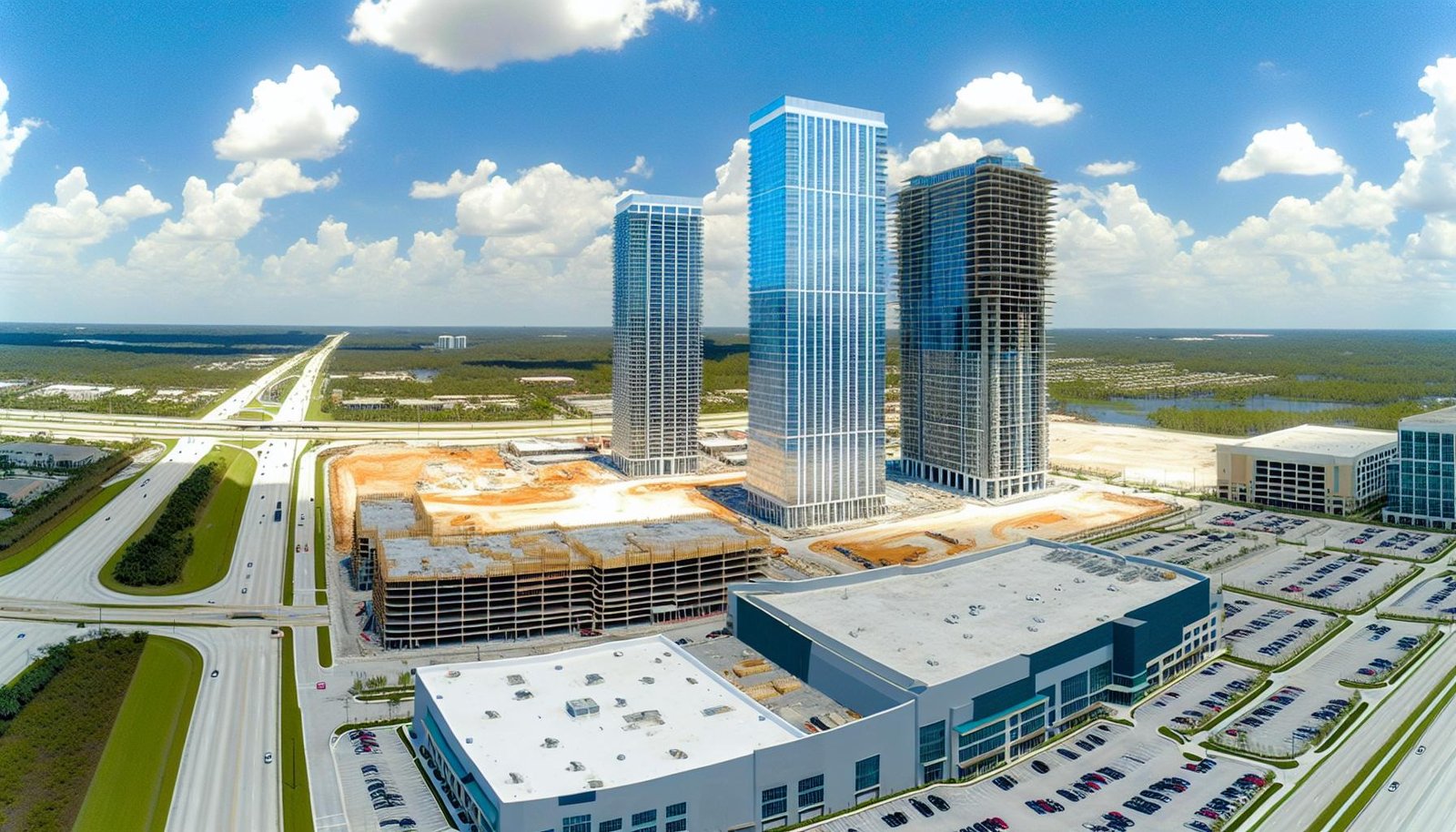
The commercial landscape of South Florida has transformed dramatically in recent years. For business developers and commercial investors, understanding how commercial construction Florida has evolved is critical to making strategic decisions that balance risk, return, and long-term viability. This article outlines the forces shaping Miami and the wider growth corridor, highlights specialized sectors such as office construction Miami, retail construction Miami, and industrial construction Miami, and explains why experienced Miami commercial builders are essential partners for successful projects in 2025.
Why Florida’s Growth Corridor Matters to Investors
Florida’s growth corridor — with Miami-Dade County at its core — remains one of the fastest-evolving commercial regions in the United States. Population inflows, a rising business-friendly climate, and strong tourism and logistics networks have generated sustained demand for modern commercial assets. For stakeholders focused on commercial construction Florida, this means continuous opportunity across asset classes, from office and retail to industrial and mixed-use developments.
- Population and employment growth: In 2025, Miami continues to attract professionals and companies relocating from other states, increasing demand for office building construction in Miami Florida.
- Logistics and distribution: Proximity to ports and an expanding interstate and last-mile network are driving Miami industrial construction services.
- Retail reinvention: Retail construction projects are shifting to experiential concepts that combine commerce, hospitality, and community space.
Market Drivers and Investment Considerations
Commercial construction in Miami-Dade and the broader South Florida region is influenced by a mix of macroeconomic and local drivers. Investors and business developers must evaluate market fundamentals alongside development-specific variables to ensure successful outcomes.
Key market drivers
- Demographic shifts: An influx of high-income households and a growing Hispanic business community.
- Capital flows: Domestic and international capital seeking yield in stable, high-growth markets.
- Infrastructure investment: Port expansion, airport improvements, and multimodal logistics corridors.
- Regulatory landscape: Local permitting processes and resiliency regulations influencing project timelines and budgets.
Understanding these drivers helps evaluate commercial construction costs in Miami FL, project feasibility, and long-term asset performance. Developers must also consider climate resilience and sustainability as core elements of modern commercial construction strategy.
Sector-Specific Trends: Office, Retail, and Industrial
Different commercial sectors have distinct dynamics. Below we explore the primary sectors that business developers and commercial investors should prioritize when evaluating opportunities in the Miami growth corridor.
Office construction Miami: adapting to hybrid work
The demand curve for office space has shifted since the pandemic. In 2025, office requirements emphasize flexible layouts, amenity-rich environments, and health-forward building systems. Developers focusing on office construction Miami are targeting prime locations with strong transit connectivity and proximity to mixed-use districts.
- Design focus: Flexible floor plates, increased ventilation standards, and integrated technology for hybrid work modes.
- Tenant expectations: Class A spaces with on-site amenities like fitness centers, food and beverage, and collaborative spaces.
- Investment insight: Office projects near transit and residential density continue to outperform, particularly when repositioned with modern systems.
Retail construction Miami: experiential and omnichannel hubs
Retail construction in Miami is no longer about maximizing leasable square feet; it is about creating destinations. Investors in retail construction Miami seek projects that integrate dining, entertainment, and community events to drive foot traffic and higher sales per square foot.
- Omnichannel integration: Click-and-collect infrastructure, micro-fulfillment, and experiential store formats.
- Site selection: Mixed-use corridors and high-tourism nodes remain attractive for higher rent capture.
- Local search behavior: Common queries such as “Miami retail construction contractor near me” reflect the market’s need for trusted local execution partners.
Industrial construction Miami: logistics, cold storage, and light manufacturing
Miami’s role as a logistics hub has solidified the need for modern industrial facilities. Miami industrial construction services now include build-to-suit warehouses, cold storage for perishables, and last-mile distribution centers tailored for e-commerce growth.
- Strategic location: Facilities near ports, intermodal yards, and major highways command premium rents.
- Specialized facilities: Cold-chain logistics and flexible industrial floors for light manufacturing.
- Developer strength: Industrial projects require builders familiar with heavy-duty loading, HVAC, and specialized utility infrastructure.
Understanding Commercial Construction Costs in Miami FL
Estimating commercial construction costs in Miami FL requires careful analysis of materials, labor, regulatory constraints, and site-specific conditions such as flood zone classifications. Key cost drivers include:
- Labor availability and wage inflation: Skilled labor shortages can extend timelines and increase cost per square foot.
- Material pricing volatility: Steel, concrete, and specialty finishes are subject to global supply pressures that impact budget contingencies.
- Resiliency and code requirements: Elevated foundations, impact-resistant glazing, and enhanced stormwater systems add capital expense but protect long-term asset value.
- Permitting and entitlement: Delays in approvals can extend soft costs and holding expenses.
Working with experienced Miami commercial builders helps investors refine cost assumptions and identify opportunities to optimize design for value without compromising resilience or tenant expectations.
Permitting and Regulatory Pathways: How to Obtain Permits for Commercial Construction in Miami
A common concern for out-of-state investors is regulatory complexity. The process of how to obtain permits for commercial construction in Miami includes multiple agencies and jurisdictional requirements:
- Local building department: Miami-Dade or municipal building permits for structural, mechanical, electrical, and plumbing systems.
- Zoning and land use: Entitlements, variances, and community meetings may be required for uses or intensity beyond current zoning.
- Environmental and resiliency reviews: Floodplain analysis, stormwater management, and environmental resource permits where applicable.
- Specialized permits: Driveway access, signage, and health department approvals for food service components.
To navigate these processes efficiently, developers benefit from a local partner who understands the nuances of Miami-Dade approvals. PK Development Group leverages long-standing relationships with permitting authorities and consultants to streamline entitlement pathways and mitigate schedule risk.
Sustainable Commercial Construction in Miami and Green Building Practices
Sustainability is no longer a differentiator — it is a requirement for long-term asset competitiveness. Search terms like sustainable commercial construction in Miami and green building Miami commercial construction reflect rising investor and tenant demand for energy-efficient, resilient properties.
Key components of sustainable commercial projects
- Energy efficiency: High-performance envelopes, LED lighting, and efficient HVAC systems reduce operating costs.
- Water conservation: Low-flow fixtures, smart irrigation, and drought-resistant landscaping are critical in South Florida’s climate.
- Resiliency: Elevated mechanical systems, flood-resistant materials, and enhanced drainage mitigate climate risks.
- Certifications: LEED, WELL, and local resiliency standards add market value and attract high-quality tenants.
For investors, sustainable construction reduces operational risk and can improve capitalization rates. Projects that incorporate green building strategies often achieve higher occupancy and tenant retention.
Selecting the Right Miami Commercial Builder
Choosing from among the best commercial construction companies in Miami requires more than comparing bids. Investors should evaluate experience, financial stability, in-house capabilities, and track record across specific project types.
Evaluation checklist for Miami commercial builders
- Sector expertise: Experience with office building construction in Miami Florida, retail rollouts, or industrial facilities as appropriate to your project.
- Local knowledge: Familiarity with Miami-Dade permitting, local subcontractor networks, and supply chains.
- Quality and safety programs: Robust QA/QC, safety records, and third-party certifications.
- Financial strength: Capacity to carry project risk and manage cash flow through construction cycles.
- References and completed projects: A portfolio of successful projects that demonstrate delivery on time and on budget.
While many investors search for options like “Miami retail construction contractor near me,” the most effective selection process pairs competitive pricing with demonstrated local experience and a commitment to collaborative project management.
Commercial Development Trends in South Florida 2025
Looking ahead, the market will be shaped by the trends captured by the phrase commercial development trends in South Florida 2025. Developers and investors should watch the following shifts closely:
- Adaptive reuse and repositioning: Converting underperforming office or retail assets into mixed-use residential or specialized commercial uses.
- Last-mile logistics: Increasing demand for micro-distribution centers positioned near urban cores.
- Climate-forward design: Projects that prioritize flood mitigation, energy resilience, and sustainable materials to future-proof assets.
- Technology integration: Smart building systems that optimize energy, security, and tenant experience.
- Public-private partnerships: Collaboration for infrastructure and transit-adjacent development to unlock higher densities.
Understanding these trends allows commercial investors to target opportunities that will outperform in 2025 and beyond.
PK Development Group: Delivering Turnkey Commercial Solutions
As a Miami-based developer, PK Development Group (PKDG) brings deep expertise across the full commercial development lifecycle: site selection, entitlement, design coordination, construction management, and asset stabilization. Our approach blends strategic vision with executional rigor to deliver value for investors and tenants.
Core strengths of PKDG in commercial construction Florida
- Integrated project delivery: We coordinate design, procurement, and construction to control cost and schedule.
- Local knowledge: Decades of experience navigating Miami-Dade permitting and zoning environments.
- Sector breadth: Proven success in office, retail, industrial, and mixed-use projects across Miami commercial construction portfolios.
- Sustainability and resiliency: Incorporating green building Miami commercial construction principles to future-proof assets.
Our team’s track record positions PKDG among the leading candidates when evaluating the best commercial construction companies in Miami for sophisticated, capital-intensive projects.
Case Studies: Representative Projects and Outcomes
Investors benefit from seeing specific examples of how development strategy and construction execution deliver measurable returns. Below are anonymized summaries illustrating PKDG’s typical project impact.
Class A Office Repositioning — Central Business District
- Scope: Repositioned an underperforming mid-rise office into a modern, amenity-driven workplace.
- Approach: Retrofitted façade, improved MEP systems, and introduced tenant-focused amenities to increase occupancy.
- Outcome: Achieved higher net effective rents, reduced operating expenses through efficiency upgrades, and improved tenant retention.
Build-to-Suit Logistics Facility — Port-Adjacent
- Scope: Delivered a high-clearance distribution center with cold storage capabilities for a global logistics operator.
- Approach: Coordinated specialized mechanical systems, cold-chain integration, and expedited permitting for operational needs.
- Outcome: Shortened lease-up timeframe and secured a long-term tenant with strong credit, stabilizing the asset rapidly.
Retail Destination Redevelopment — Mixed-Use Corridor
- Scope: Converted a retail center into an experiential destination with outdoor dining, retail pop-ups, and flexible event space.
- Approach: Phased construction to maintain cash flow, integrated omnichannel infrastructure, and curated tenant mix.
- Outcome: Increased foot traffic and sales per square foot, boosting overall center valuation.
Financing, Risk Management, and Timeline Optimization
Commercial development success depends not only on design and construction but also on financing structure and risk mitigation. PKDG works closely with partners to optimize capital stacks and manage contingencies.
- Debt and equity structuring: Aligning sponsor equity with construction loans and preferred equity to control dilution and risk.
- Schedule acceleration: Fast-track construction protocols and early procurement strategies to reduce hold costs.
- Contingency planning: Assessing supply chain vulnerabilities and building budget reserves for materials and labor volatility.
These elements help contain commercial construction costs in Miami FL while protecting investor returns through disciplined project controls.
Checklist for Business Developers and Commercial Investors
Prior to committing capital, stakeholders should verify the following project readiness items to reduce execution risk:
- Clear title and environmental due diligence.
- Preliminary entitlement strategy and timeline.
- Market demand validation for targeted asset type (office, retail, industrial).
- Budget with realistic allowances for resiliency and sustainability upgrades.
- Engaged local construction partner with verifiable references for similar projects.
Investors should ask prospective partners for examples of office building construction in Miami Florida or Miami industrial construction services to confirm capability and fit.
How PK Development Group Supports Investment Success
PKDG’s methodology is designed to reduce uncertainty and deliver predictable outcomes. Key program features include:
- Early-stage advisory: Market analysis, feasibility, and site optimization to align scope with demand.
- Permitting and entitlement management: Proactive coordination to address “how to obtain permits for commercial construction in Miami” questions early in the process.
- Construction efficiency: Value engineering and procurement strategies that balance cost and performance.
- Asset stabilization: Lease-up strategies and operational handoff to maximize net operating income post-delivery.
Looking Ahead: Investment Opportunities and Risks in 2025
As we move through 2025, investors should be mindful that while South Florida presents robust opportunities, the market also carries specific risks. Rising construction costs, evolving building codes, and climate-related challenges require a sophisticated development partner who can translate strategy into executed value.
Opportunities abound in transit-oriented developments, industrial conversions, and experiential retail centers. By partnering with experienced Miami commercial builders and developers, investors can capitalize on favorable demand dynamics while managing exposure to cost and regulatory volatility.
Final Considerations for Choosing a Local Partner
When vetting potential partners, prioritize a firm that demonstrates:
- Proven delivery: Completed projects in Miami and South Florida with measurable financial outcomes.
- Cross-disciplinary expertise: Capability across entitlement, construction, sustainability, and asset management.
- Local relationships: Strong working relationships with permitting authorities, subcontractors, and suppliers.
- Transparent communication: Clear reporting on schedule, budget, and risk mitigation strategies.
Investors searching for the best commercial construction companies in Miami should expect a combination of strategic insight and reliable execution. PK Development Group offers both: a local presence, sector-specific experience, and a track record of delivering complex commercial projects on schedule and within budget.
Next Steps for Business Developers and Commercial Investors
If you are evaluating opportunities in Miami’s growth corridor, consider the following pragmatic next steps:
- Engage a local advisory team for initial market and site due diligence.
- Prioritize projects with clear demand drivers and contingency plans for resiliency costs.
- Request detailed proposals from experienced Miami commercial builders that include lifecycle cost analysis and sustainability options.
- Validate timelines for permitting and construction to align capital deployment with market windows.
For tailored guidance, speak with development partners who specialize in Miami commercial construction and have deep experience across office, retail, and industrial asset classes.
Discover Our Commercial Portfolio
Discover our commercial portfolio — review case studies and learn how PK Development Group has partnered with investors to deliver value across Miami commercial construction projects. Our team can help you evaluate opportunities, structure deals, and execute developments that meet your financial and strategic goals.
How can a disciplined, locally experienced development partner help you capture value in Miami’s evolving commercial market?